
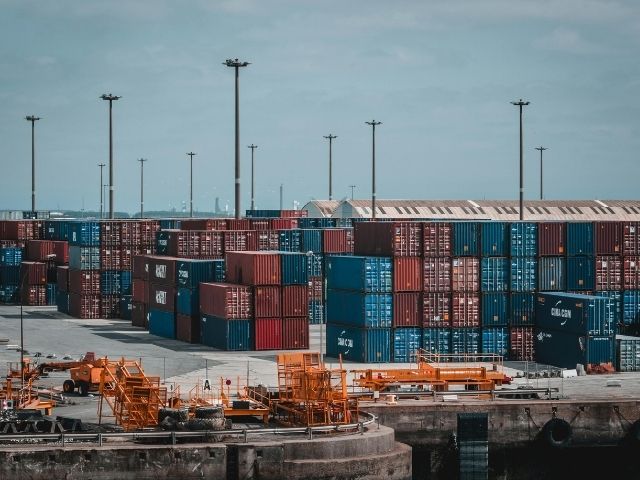
In today’s global economy, moving goods from factories to consumers depends on a complex transportation network. Two major players in that system are railroads and trucking.
Traditionally seen as competitors, these two modes of transport are now more important to each other than ever for an efficient, affordable, and resilient supply chain.
The Strengths of Trucks and Trains
Each mode of transportation has unique advantages.
Trucks provide unmatched flexibility. They can reach almost any address, handle first-mile pickup and last-mile delivery, and adapt quickly to changing customer needs. [1]
While trains excel in moving large volumes over long distances with far lower fuel consumption and a smaller environmental footprint. A single train can carry as much freight as hundreds of trucks, which leads to big savings in fuel and reduced congestion on roads. [2]
Rather than choosing one over the other, maybe the best solution is to use both, each for what it does best.
Intermodal Transportation: A Collaborative Solution
Intermodal transportation uses more than one mode of transport in the same movement of goods without unloading the freight itself.
Typically, a container is loaded on a truck, taken to a rail terminal, moved across long distances by train, and then picked up by truck again for final delivery.
This approach offers multiple benefits:
- Lower costs: Using rail for long distances is cheaper per mile than trucking alone. [1]
- Greater reliability: Rail networks often follow fixed schedules for more predictable delivery times.[1]
- Environmental gains: Rail transport uses significantly less fuel and produces fewer emissions per ton-mile than trucks. [2]
- Improved security: Freight stays sealed in the same container throughout the journey, which reduces damage and theft risk. [3]
These advantages explain why intermodal shipments have grown rapidly and why logistics planners increasingly favor blended truck-rail networks.
A Supply Chain That Works Better Together
The idea isn’t just about saving money. It’s also about supply chain resilience.
When disruptions occur, having multiple transportation options helps keep goods moving. Rail provides capacity pressure relief when truck demand spikes, while trucking fills gaps that rail can’t serve, especially for local delivery.
Once the industry embraces collaboration rather than competition, overall freight costs reduce and improve environmental outcomes, which will benefit companies and consumers alike. [4]
Challenges and the Road Ahead
Despite the clear benefits, the rail and trucking industries still face challenges. Coordination between carriers can be complex and requires investment in logistics technology and real-time data sharing.
Infrastructure limitations tend slow down transfers between trucks and trains. While truck carriers still dominate for perishable goods and time-sensitive deliveries, where flexibility is critical. [5]
Still, advances in digital tools like transportation management systems (TMS), AI-driven routing, and better tracking are making it easier for carriers to plan efficient intermodal routes.
A Partnership for the Future
Rather than viewing trucking and railroads as rivals, the modern logistics ecosystem needs to treat them as strategic partners.
By playing to their respective strengths, they reduce costs, improve reliability, cut emissions, and build a stronger, more adaptable supply chain.
This is where the GRENNEX Transportation Management System becomes the connective layer that makes true collaboration possible. Through the Unified Logistics Control Platform our TMS offers, we take away fragmented systems and manual handoffs, while business partners operate and connect from a single platform, supported by our flexible ERP integrations and predictive Agentic AI.
In a world where customer expectations continue to rise and supply chain disruptions are more common, this collaborative approach isn’t just smart.
It’s essential.
Schedule a demo with GRENNEX TMS and experience clearer visibility, smoother coordination, and a platform built for modern logistics.
Sources
[2] https://www.aar.org/issue/freight-rail-intermodal/
[3 ]https://igps.net/benefits-of-intermodal-transportation-in-the-supply-chain/